
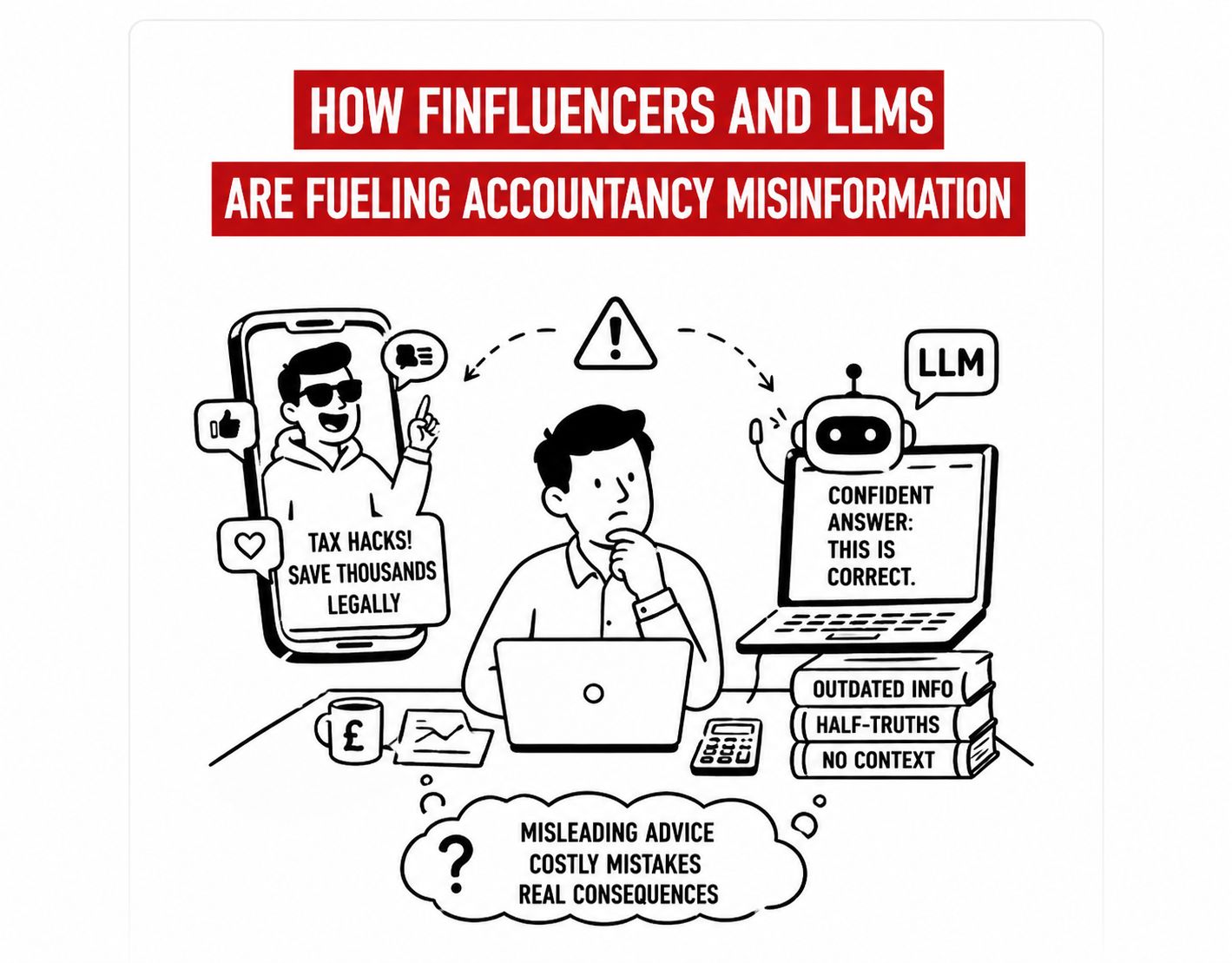
Finfluencers, LLMs and the Accountancy Misinformation Economy
The way people consume financial and accounting information has changed dramatically in recent years. What once came primarily from qualified professionals, textbooks, and regulated advisory channels is now increasingly shaped by social media influencers and artificial intelligence tools. While this shift has made financial information more accessible than ever, it has also created new risks — particularly around accuracy, context, and accountability.
The rise of “finfluencers”
Financial influencers, often known as “finfluencers,” have built large audiences on platforms like TikTok, Instagram, and YouTube by breaking down tax rules, investment tips, and business advice into short, engaging content.
Their appeal is easy to understand. Complex accounting concepts are simplified into bite-sized videos and posts that feel practical and relatable. For small business owners and younger audiences, this content often feels more approachable than traditional financial advice.
However, much of this content is produced without formal qualifications or regulatory oversight. As a result, advice can be oversimplified, misleading, or in some cases incorrect. Tax rules are rarely as straightforward as social media content suggests.
When AI enters the equation
The rise of large language models (LLMs) has added a new layer to this issue. AI tools can generate fast explanations for accounting and tax questions, but they are not always accurate or context-aware.
These systems do not understand tax law in a human sense — they generate responses based on patterns in training data. This can lead to outdated or incorrect information, especially in complex or jurisdiction-specific cases.
When AI-generated content is reused on social media, small inaccuracies can quickly become widely shared misinformation.
The misinformation loop
The combination of finfluencers and AI tools has created a feedback loop:
- AI generates simplified financial explanations
- Content creators repurpose them into posts and videos
- Algorithms amplify engaging content
- Users adopt advice without verification
This cycle makes it difficult for non-experts to distinguish between accurate guidance and misleading information.
Why SMEs are particularly vulnerable
Small and medium-sized enterprises (SMEs) are especially exposed. Many rely on online resources for guidance on tax, VAT, payroll, and compliance due to limited access to in-house expertise.
While online advice is convenient, incorrect financial decisions can lead to penalties, compliance issues, and long-term financial risks.
The role of regulation and professionals
Regulators and professional bodies have raised concerns about unregulated financial advice online. However, enforcement remains challenging due to the speed and scale of digital content distribution.
This has increased pressure on qualified accountants to maintain visibility online and provide accurate, contextual explanations that counter misinformation.
Conclusion
Finfluencers and AI tools have transformed access to financial information, but they have also increased the spread of misinformation. While they can be useful starting points, they cannot replace professional accounting advice.
In an increasingly digital financial landscape, accuracy and professional judgement remain essential.