HMRC Urges Employers to Reclaim PAYE Overpayments


HMRC Urges Employers to Reclaim PAYE Overpayments


HMRC Urges Employers to Reclaim PAYE Overpayments


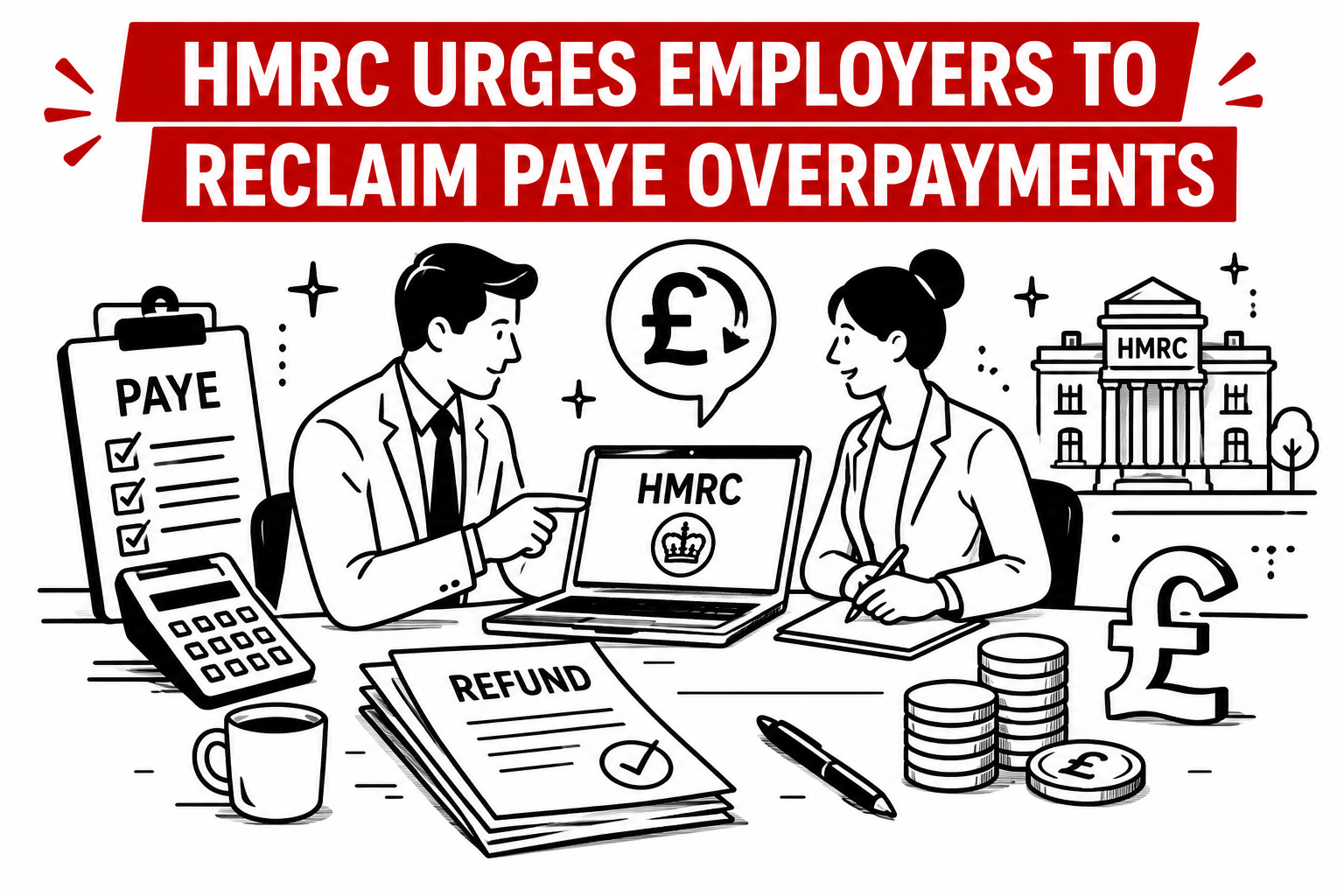
Employers who believe they have overpaid their Pay As You Earn (PAYE) liabilities are being encouraged to review their records and seek refunds from HM Revenue & Customs (HMRC).

According to HMRC guidance, businesses may be entitled to a repayment if they have paid more tax than was due during the current or a previous tax year. Overpayments can arise for several reasons, including duplicate payments, reporting errors, incorrect calculations, or adjustments that were not reflected in payroll submissions.

Employers are advised to compare the amounts paid to HMRC with the liabilities recorded in their tax accounts to identify any discrepancies. Businesses may also discover overpayments linked to statutory payments, employee tax adjustments, or corrections made to previous payroll reports.

To submit a refund claim, employers must provide key information such as their PAYE reference number, business details, bank account information, the tax year involved, and an estimate of the amount overpaid. Claims can generally be made online, while alternative arrangements are available for those unable to use digital services.

HMRC said that claims will be reviewed before any repayment is authorised. Where outstanding tax liabilities exist, the department may offset any approved refund against those debts before releasing any remaining balance.

Payroll professionals have welcomed the reminder, noting that regular reconciliation of payroll records can help businesses avoid tying up cash unnecessarily and ensure tax obligations are accurately reported.

Experts recommend that employers maintain up-to-date payroll records and promptly investigate any differences between reported liabilities and payments made to HMRC.

For further information, businesses are encouraged to consult official HMRC guidance on PAYE overpayment refunds.


Rising Taxes and Costs Push Small Businesses Toward Breaking Point


Rising Taxes and Costs Put Growing Pressure on Small Businesses

Rising Taxes and Costs Put Growing Pressure on Small Businesses

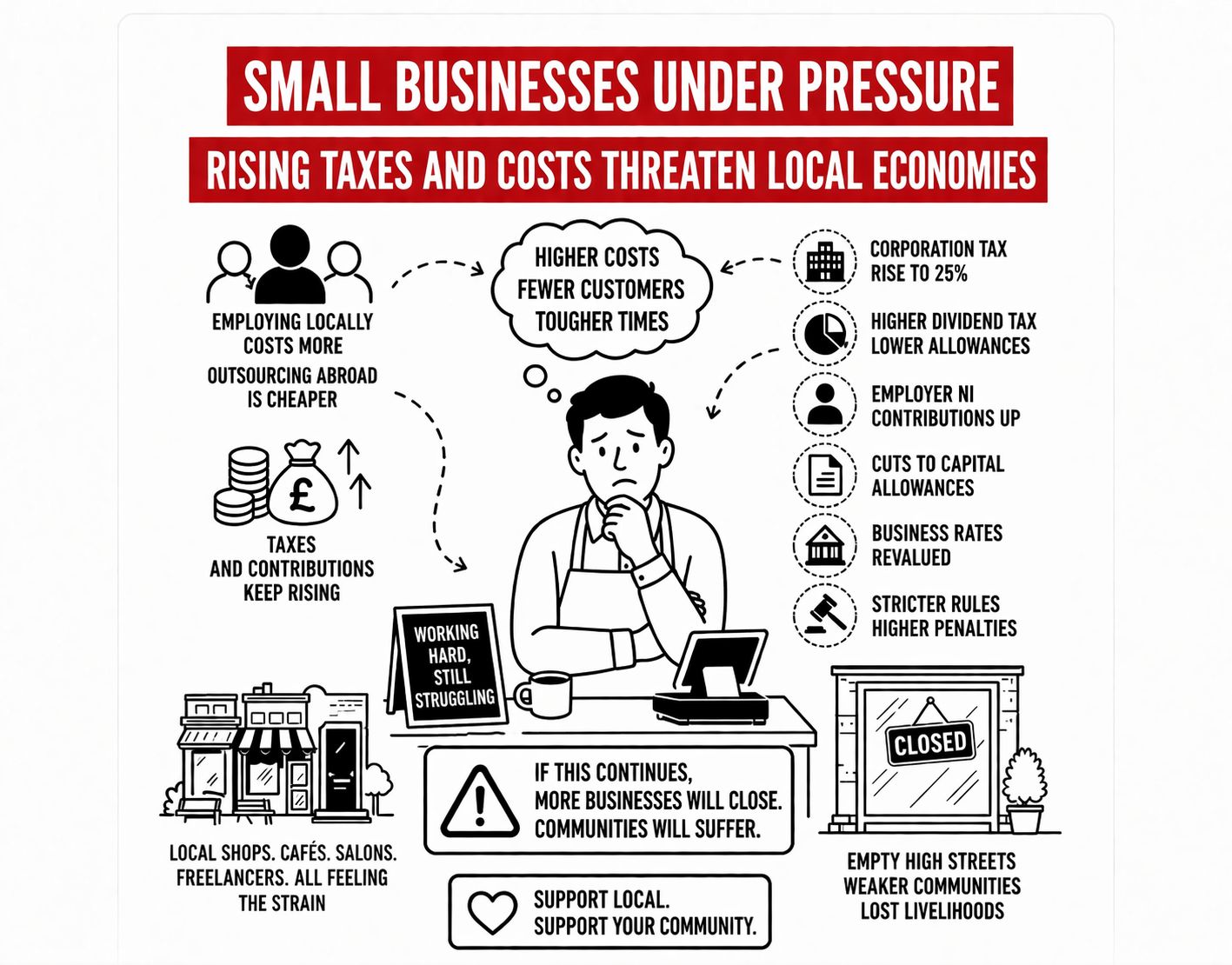
Small businesses are facing increasing challenges as rising taxes and operational costs continue to put pressure on local economies. A recent discussion circulating on social media highlights how running a small business is becoming more difficult, with many owners struggling to stay afloat.

According to the commentary, employing local workers now costs significantly more due to higher taxes and employer contributions. This has led to concerns that outsourcing services abroad is becoming a more affordable option, raising questions about the long-term sustainability of local employment.

Several financial changes introduced this year have added to the burden. These include a rise in corporation tax to 25%, increases in dividend tax alongside reduced allowances, and higher employer National Insurance contributions. Additionally, cuts to capital allowances, revaluation of business rates, and stricter penalties have further increased costs for business owners.

As a result, many small businesses such as cafés, salons, freelance services, and local shops are reportedly struggling to manage expenses while maintaining operations. Observers argue that while paying tax is necessary, the current structure may be placing excessive strain on small enterprises.

The growing concern is that if these challenges continue, local high streets could see more closures, impacting not only business owners but also communities that rely on them.


How Finfluencers and LLMs Are Fueling Accountancy Misinformation


Finfluencers, LLMs and the Accountancy Misinformation Economy


Finfluencers, LLMs and the Accountancy Misinformation Economy

The way people consume financial and accounting information has changed dramatically in recent years. What once came primarily from qualified professionals, textbooks, and regulated advisory channels is now increasingly shaped by social media influencers and artificial intelligence tools. While this shift has made financial information more accessible than ever, it has also created new risks — particularly around accuracy, context, and accountability.

The rise of “finfluencers”

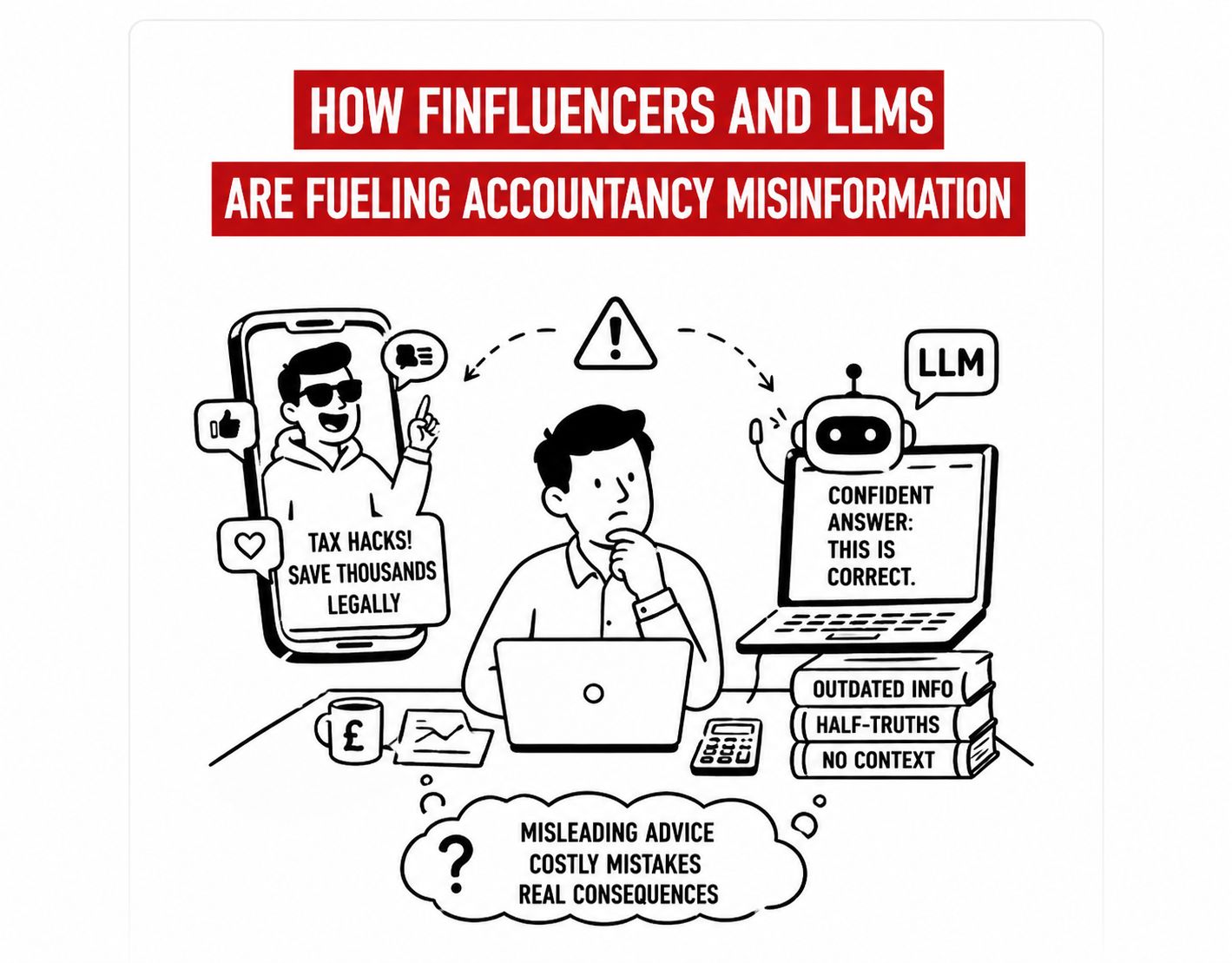
Financial influencers, often known as “finfluencers,” have built large audiences on platforms like TikTok, Instagram, and YouTube by breaking down tax rules, investment tips, and business advice into short, engaging content.

Their appeal is easy to understand. Complex accounting concepts are simplified into bite-sized videos and posts that feel practical and relatable. For small business owners and younger audiences, this content often feels more approachable than traditional financial advice.

However, much of this content is produced without formal qualifications or regulatory oversight. As a result, advice can be oversimplified, misleading, or in some cases incorrect. Tax rules are rarely as straightforward as social media content suggests.

When AI enters the equation

The rise of large language models (LLMs) has added a new layer to this issue. AI tools can generate fast explanations for accounting and tax questions, but they are not always accurate or context-aware.

These systems do not understand tax law in a human sense — they generate responses based on patterns in training data. This can lead to outdated or incorrect information, especially in complex or jurisdiction-specific cases.

When AI-generated content is reused on social media, small inaccuracies can quickly become widely shared misinformation.

The misinformation loop

The combination of finfluencers and AI tools has created a feedback loop:

  • AI generates simplified financial explanations
  • Content creators repurpose them into posts and videos
  • Algorithms amplify engaging content
  • Users adopt advice without verification

This cycle makes it difficult for non-experts to distinguish between accurate guidance and misleading information.

Why SMEs are particularly vulnerable

Small and medium-sized enterprises (SMEs) are especially exposed. Many rely on online resources for guidance on tax, VAT, payroll, and compliance due to limited access to in-house expertise.

While online advice is convenient, incorrect financial decisions can lead to penalties, compliance issues, and long-term financial risks.

The role of regulation and professionals

Regulators and professional bodies have raised concerns about unregulated financial advice online. However, enforcement remains challenging due to the speed and scale of digital content distribution.

This has increased pressure on qualified accountants to maintain visibility online and provide accurate, contextual explanations that counter misinformation.

Conclusion

Finfluencers and AI tools have transformed access to financial information, but they have also increased the spread of misinformation. While they can be useful starting points, they cannot replace professional accounting advice.

In an increasingly digital financial landscape, accuracy and professional judgement remain essential.


S&W Expands into France with Vachon Acquisition


S&W Expands into France with Vachon Acquisition


S&W Expands into France with Vachon Acquisition

Professional services group S&W has entered the French market through the acquisition of Paris-based accountancy firm Vachon, marking a significant step in its international growth strategy.

The deal, supported by Apax Funds, strengthens S&W’s ability to serve clients operating across borders and enhances its presence in Europe. It follows the firm’s previous expansion into Ireland, further building its international network.

Founded in 1997, Vachon provides a full range of services including audit, accounting, tax, payroll, and advisory support. The firm works with small and mid-sized businesses, large multinational companies, and private investors. Its team of around 60 bilingual professionals, including 14 partners, is recognised for expertise in international accounting standards and cross-border financial matters.

As part of the agreement, Vachon will continue to operate under its existing brand, maintaining its established reputation in the French market.

S&W’s leadership highlighted France as a key market for clients expanding into Europe, noting that Vachon’s technical expertise and local knowledge will complement the firm’s existing capabilities. Meanwhile, Vachon’s leadership described the acquisition as a natural progression that will allow the firm to broaden its international reach while continuing to deliver personalised services.

Overall, the acquisition represents a strategic move to strengthen cross-border support for clients and expand service offerings across multiple European markets.


Payroll Professionals Asked to Share Readiness Ahead of Major SSP Changes in April 2026

Payroll Professionals Asked to Share Readiness Ahead of Major SSP Changes in April 2026

With significant changes to Statutory Sick Pay (SSP) set to take effect from 6 April 2026, payroll professionals across the UK are being encouraged to share how prepared they are for the transition.

The upcoming reforms mark one of the most substantial updates to SSP in decades, bringing wide-ranging implications for employers, payroll systems, and workforce management. As organisations gear up for these changes, industry bodies are seeking feedback to better understand how businesses are adapting.

A newly launched quick poll invites payroll teams to reflect on their current level of readiness. Responses range from organisations that have fully updated their systems to those still waiting for further guidance or yet to begin preparations.
Read more

The feedback collected will help highlight any gaps in understanding or implementation, enabling better support for payroll professionals during this transition period.

The SSP reforms, which come into force in April 2026, are expected to expand eligibility and change how payments are calculated, making it essential for employers to review their processes in advance.
Official guidance

Payroll teams are encouraged to take part in the poll and share their views, helping shape future guidance and ensuring the profession is well represented in discussions with policymakers.

Big Payroll Changes Coming in 2026

Big Payroll Changes Are Coming — And UK Businesses Must Act Now

Major changes to UK payroll are on the way, driven by artificial intelligence, tighter HMRC reporting requirements, and updated rules around employee benefits. Automation is transforming how businesses calculate pay and manage compliance, while new digital reporting standards mean less room for error and greater scrutiny from tax authorities. Employers who fail to adapt risk penalties, inefficiencies, and unexpected tax costs. Reviewing payroll systems, updating processes, and staying ahead of regulatory updates will be essential for businesses looking to remain compliant and competitive in 2026.

UK Businesses Urged to Review Payroll Processes as Compliance Pressures Grow

UK employers are being urged to review their payroll processes as rising compliance demands and workforce changes place increasing pressure on in-house teams.

Payroll specialists say many small and medium-sized businesses are struggling to keep pace with evolving HMRC requirements, employee expectations for accurate and timely pay, and the growing complexity of modern work arrangements, including hybrid working and flexible hours.

Industry experts note that payroll errors remain one of the most common causes of employee dissatisfaction, often leading to disputes, delayed payments, or incorrect tax deductions. With HMRC continuing to emphasise real-time reporting accuracy, even minor mistakes can result in penalties or additional administrative work for employers.

At the same time, businesses are facing tighter margins and are being asked to do more with fewer resources. As a result, many are reassessing whether their current payroll systems are fit for purpose. Cloud-based payroll solutions and managed payroll services are increasingly being adopted to reduce risk, improve accuracy, and free up internal teams to focus on strategic priorities.

“Payroll is no longer just an administrative function,” said a payroll industry spokesperson. “It sits at the heart of employee trust and regulatory compliance. Businesses that invest in reliable, well-supported payroll processes are better positioned to avoid costly errors and support staff confidence.”

With the new tax year approaching, payroll providers are encouraging employers to act early by reviewing payroll data, updating systems, and ensuring staff are trained on the latest requirements. Taking proactive steps now, experts say, can help businesses stay compliant and avoid disruption in the months ahead.

HMRC’s Little Known £150 Festive Party Rule Lets Businesses Celebrate Tax Free

UK business owners are being reminded of a valuable tax free perk available throughout the year, a lesser known HMRC rule that allows companies to spend up to £150 per person on staff events without triggering any tax liabilities.

The rule, often referred to as HMRC’s hidden festive allowance, is designed to encourage employers to reward their teams and boost staff morale. Under the exemption, companies can claim back the full cost of events such as Christmas dinners, team outings, parties, or even a summer get together, as long as the total annual cost per employee does not exceed £150.

The allowance is surprisingly broad. It covers food, drinks, entertainment, venue hire, decorations, and even transport to and from the event. This means that everything from a three course Christmas meal to a staff night out or an activity day could qualify, provided it is a genuine social event.

There are, however, strict rules that businesses must follow. The event must be open to all employees, not just managers or directors. It must also be an annual or occasional social function, rather than a reward for specific individuals. Most importantly, the £150 limit applies to the total cost per head for the entire year. If a business spends £151, the exemption is lost and the whole amount becomes taxable.

Many companies do not realise that the exemption can be split across multiple events. For example, a business could host a summer barbecue costing £60 per person and a Christmas meal costing £90 per person, both fully tax free as long as the combined total stays under the annual limit.

Tax experts say the rule is underused, particularly among small businesses and new directors who assume company funded parties will automatically attract payroll taxes. In reality, HMRC specifically created the exemption to support employee wellbeing and to encourage companies to invest in workplace culture.

With rising costs affecting businesses across the country, the £150 allowance offers an opportunity to celebrate the festive season, strengthen team morale, and do so in a completely tax efficient way. Many accountants are now urging employers to use the allowance before the end of the tax year to make the most of a benefit that often goes unnoticed.

Autumn Statement Shifts Hidden Costs Onto Businesses Despite Headline Tax Promises

The government’s Autumn Statement has been presented as a win for working people, with announcements such as frozen train fares and rises to both the minimum wage and the National Living Wage. But while these measures grab positive headlines, business leaders are warning that the true impact of the budget lies beneath the surface and it’s employers who will pay the price.

Although the government reiterated its promises not to raise the taxes that directly affect the general public, such as income tax, national insurance, and VAT, the Statement revealed a different strategy. Instead of increasing headline rates, the pressure is being quietly transferred onto businesses: the very people who create jobs, employ staff, and keep the economy moving.

Industry observers say this approach is intentional. By freezing thresholds and allowances, altering payroll rules, and introducing policy tweaks that increase operational costs, the government can raise revenue without technically breaking its manifesto pledges. These changes rarely feature in the headline but they significantly affect the cost of running a business.

For business owners, this budget is impossible to ignore. The adjustments directly influence how much it costs to employ people, how much owners can pay themselves, and how they plan for the year ahead. Without reviewing their margins, businesses risk losing profit. But increasing prices to compensate can make them appear as though they’re passing the burden onto customers.

The true consequences of these fiscal decisions won’t be immediately obvious. Much of the impact is buried in the fine print-details that the average voter is unlikely to examine closely.

In response, experts are urging business owners to fully understand the changes. A plain-English breakdown outlining what’s shifting, what it means for businesses, and what steps owners should be considering next is now being shared with those seeking clarity.

📰 AI on the Payslip: How Artificial Intelligence is Transforming Payroll in the UK

In boardrooms and back-offices alike, payroll has long been viewed as a routine process: calculate wages, deduct taxes, submit to HM Revenue & Customs (HMRC), pay employees. But today, the UK is witnessing a quiet revolution. Artificial intelligence is stepping into payroll, not just as a convenience tool, but as a strategic driver of efficiency, compliance, and employee experience.
The New Frontier: AI Enters Payroll
In 2025, 42 percent of UK companies report using AI-powered tools from chatbots for employee queries to anomaly detection in payroll data. These firms outpace the European average by 12 percentage points. Meanwhile, investment in generative AI rose from 14 percent in 2024 to 22 percent in 2025 among UK employers.
Firms are increasingly treating payroll not as a line-item process but as a strategic function that must adapt to labour regulation, data security, and changing work models.
How AI Is Changing the Game
AI is being applied in payroll in several ways:
• Employee self-service: Virtual agents answer pay slip and tax queries, reducing HR workloads.
• Error detection: AI flags anomalies like unexpected overtime or misclassifications, improving compliance.
• Task automation: Timesheet validation, tax updates, and repetitive calculations are streamlined.
• Data-driven insights: Payroll analytics inform workforce planning and cost management.
• Improved employee experience: Faster issue resolution boosts trust and morale.
Benefits Seen Across UK Businesses:
• 72 percent of companies report cost savings with AI-enhanced payroll processes.
• Payroll teams can shift focus from data entry to strategic functions.
• Errors are reduced, compliance is easier, and employees feel more confident in pay accuracy.
Risks and Limitations:
• Human oversight remains essential for complex decisions.
• Smaller firms lag behind, with only 16 percent fully automating payroll tasks.
• Data security and trust issues are critical, especially with sensitive payroll information.
The Road Ahead
For UK firms, AI in payroll is no longer optional. It can improve compliance, cut costs, enhance employee satisfaction, and give leaders actionable insights. The integration of AI is a quiet revolution in back offices transforming what used to be a monthly formality into a strategic, intelligent process.
In the quiet hum of payslips being generated, AI is reshaping the future of work one pay run at a time.